How Service Dogs Are Changing Lives for People with Invisible Disabilities
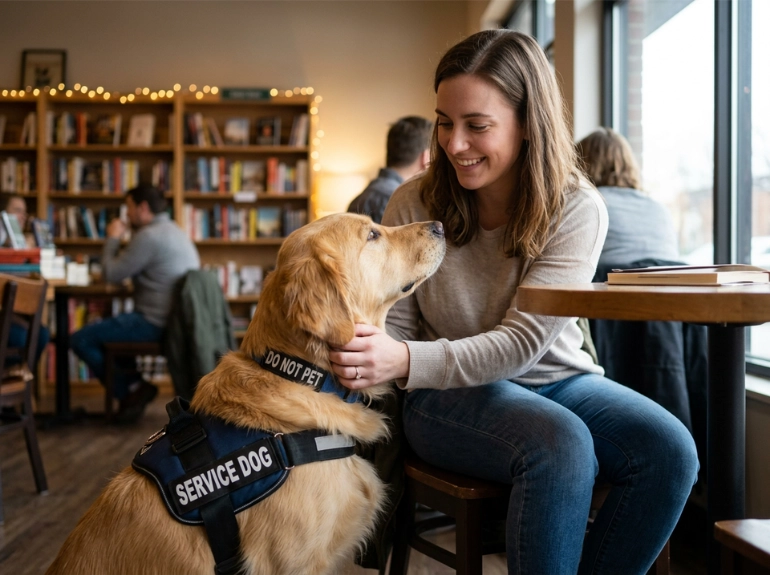
Not all disabilities are visible. Millions of Americans live with conditions like PTSD, epilepsy, diabetes, and autism — and for many of them, a service dog provides independence, safety, and a lifeline that no medication alone can offer.
What Are Invisible Disabilities?
The term "invisible disability" refers to any physical, mental, or neurological condition that is not immediately apparent to others but substantially limits one or more major life activities. According to the Invisible Disabilities Association, an estimated 10% of Americans — roughly 33 million people — live with an invisible disability.
Common invisible disabilities that service dogs are trained to assist with include:
- Post-Traumatic Stress Disorder (PTSD): Affecting approximately 6% of the U.S. population at some point in their lives, according to the National Center for PTSD.
- Epilepsy: 3.4 million Americans live with active epilepsy, per the CDC.
- Type 1 Diabetes: Approximately 1.9 million Americans have Type 1 diabetes, which requires constant blood sugar monitoring.
- Autism Spectrum Disorder (ASD): The CDC estimates that 1 in 36 children is diagnosed with ASD.
- Chronic pain conditions: Including fibromyalgia, Ehlers-Danlos syndrome, and CRPS.
Psychiatric Service Dogs: Beyond Emotional Support
It is critical to distinguish between psychiatric service dogs (PSDs) and emotional support animals (ESAs). A psychiatric service dog is trained to perform specific tasks that mitigate a user's psychiatric disability. Under the ADA, PSDs have the same legal protections as any other service dog.
Tasks performed by psychiatric service dogs include:
- Nightmare interruption: Waking a user from night terrors associated with PTSD.
- Tactile grounding: Applying deep pressure therapy during panic attacks or dissociative episodes.
- Perimeter checks: Searching a room before the user enters, reducing hypervigilance.
- Blocking: Positioning between the user and other people in crowded spaces to create physical buffer zones.
- Medication reminders: Alerting the user at specific times to take prescribed medication.
To learn more about the basics of what defines a service dog and the different types of working dogs, visit our Service Dog 101 resource page.
Seizure Response and Alert Dogs
For individuals with epilepsy, a service dog can be the difference between life and death. Seizure response dogs are trained to perform tasks during or after a seizure, such as:
- Activating a medical alert device or phone.
- Retrieving medication or a phone.
- Positioning their body to prevent the user from injuring themselves during a fall.
- Staying with the user and providing comfort during the postictal (recovery) phase.
Some dogs also develop the ability to alert before a seizure occurs. While the mechanism is not fully understood, research from institutions including the University of Rennes in France has demonstrated that some dogs can detect seizure-associated volatile organic compounds with up to 100% sensitivity. As Danny Batten explored in his article "Can Service Dogs Help Epilepsy Patients?," this area of research is opening new possibilities for people with uncontrolled seizure disorders.
Research Spotlight
A 2019 study published in Scientific Reports found that trained dogs could detect seizure-specific odor profiles across multiple patients with different types of epilepsy, suggesting a common seizure-related scent signature. This breakthrough has significant implications for the future of seizure alert dog training.
Diabetic Alert Dogs
Diabetic Alert Dogs (DADs) are trained to detect changes in blood sugar levels, typically through scent. When a user's blood glucose drops too low (hypoglycemia) or rises too high (hyperglycemia), the dog alerts the user — often before the user feels any symptoms. This early warning can prevent dangerous episodes, including diabetic comas and seizures.
Research published in the journal PLOS ONE has confirmed that trained dogs can detect isoprene, a chemical released during hypoglycemic episodes, in human breath. While continuous glucose monitors (CGMs) are an important medical tool, many users report that their DAD alerts them before their CGM registers the change — providing a crucial additional layer of safety, especially during sleep.
Autism Service Dogs
For children and adults on the autism spectrum, service dogs can provide stability in overwhelming environments. Common tasks include:
- Tethering: The child is tethered to the dog (who is handled by a parent), preventing bolting in public spaces — a leading cause of injury and death for children with ASD.
- Deep pressure therapy: Lying across the child's lap during meltdowns to provide calming sensory input.
- Social bridging: The dog acts as a social catalyst, making interactions with peers less intimidating.
- Interrupting repetitive behaviors: Nudging or pawing to redirect the user's attention.
The Stigma Challenge
Users with invisible disabilities frequently face skepticism and confrontation in public. Because their disability is not visible, they may be questioned, challenged, or accused of faking — a painful experience that can compound the very conditions the dog is trained to mitigate.
As Katie Cuppy eloquently described in her blog post "What Having a Guide Dog Means to Me," the bond between a user and their service dog is deeply personal and profoundly life-changing. Understanding that not all disabilities are visible is the first step toward creating a more inclusive world.
For more on your rights as a user, read our companion article "Understanding Your Rights: A User's Guide to Public Access Laws."
The Impact
Service dogs for invisible disabilities don't just perform tasks — they restore autonomy. For someone with PTSD who hasn't left their home in months, or a child with autism who can finally visit a grocery store without a meltdown, a service dog represents freedom. That's what Growing Up Guide Pup is all about.