From Puppy to Partner: What the First Year of Training Really Looks Like
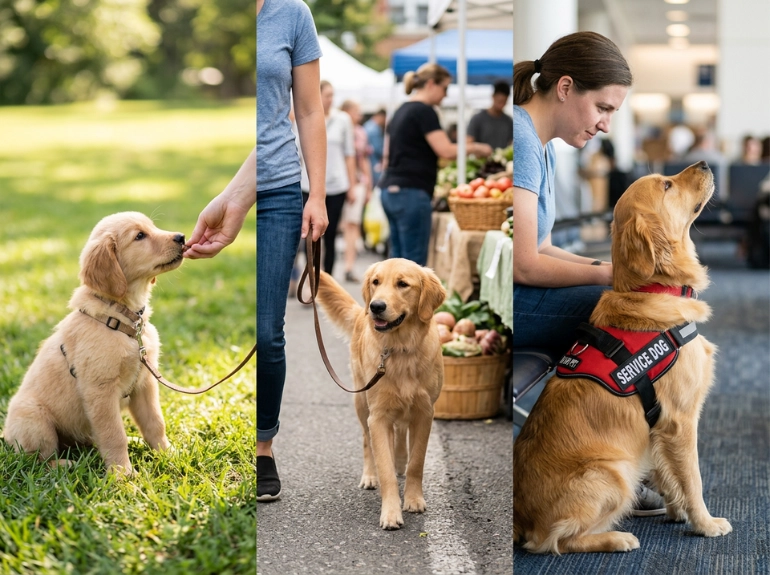
The first twelve months of a service dog's life are packed with critical socialization windows, foundational obedience, and the gradual introduction to public access work. Here's what it really takes.
Month by Month: The First Year
Raising a future service dog is not like raising a pet. Every experience, every outing, and every interaction is intentional. The goal is to produce a dog that is confident, adaptable, and focused — a dog that can work reliably in any environment for years to come. Here is what that journey typically looks like.
Weeks 0–8: The Breeder's Foundation
Before a puppy even reaches its raiser, the breeder plays a critical role. Programs like the Puppy Culture protocol and ENS (Early Neurological Stimulation) are used during the first weeks of life to build resilience and confidence. Research published in the Journal of Veterinary Behavior has shown that puppies exposed to mild stressors between days 3 and 16 develop stronger adrenal systems, better stress tolerance, and improved problem-solving abilities.
During this period, puppies are also introduced to a variety of surfaces, sounds, and gentle handling. The breeder's work during these first 8 weeks sets the trajectory for everything that follows. Learn more about our breeding efforts in our Litter Project page.
Weeks 8–12: The Critical Socialization Window
The period between 8 and 12 weeks is widely regarded by canine behaviorists as the most important socialization window in a dog's life. During this time, puppies are most open to new experiences, and positive exposures during this period have lasting effects on temperament.
- Novel surfaces: Grates, grass, tile, gravel, rubber mats, and wet pavement.
- Sounds: Traffic, sirens, vacuum cleaners, crowds, and loudspeakers.
- People: Men, women, children, people with hats, wheelchairs, canes, and uniforms.
- Environments: Pet-friendly stores, outdoor cafés, parks, and veterinary offices.
As Amie Chapman wrote in "Raising a Poodle Service Dog," every puppy is different, and the socialization approach must be tailored to the individual dog's temperament and breed characteristics.
Important Note
Socialization does not mean overwhelming the puppy. The goal is positive exposure — letting the puppy observe and process new stimuli at their own pace. Flooding a young puppy with too much too fast can create lasting fear responses.
Months 3–6: Foundation Obedience
Once the initial socialization period closes, the focus shifts to building reliable foundation behaviors. These are the skills that every service dog must master before task-specific training begins:
- Sit, down, and stand: On verbal cue and hand signal, with duration.
- Loose leash walking: Maintaining position on the user's left side without pulling.
- Recall: Coming when called, even with distractions present.
- Settle: Lying calmly under a table or beside a chair for extended periods (30+ minutes).
- Leave it: Ignoring food, other animals, and environmental distractions on cue.
Most service dog programs use positive reinforcement training methods, primarily marker-based training (clicker training). The Association of Professional Dog Trainers (APDT) and the Certification Council for Professional Dog Trainers (CCPDT) both endorse force-free methods as the most effective and humane approach for working dogs.
Months 6–9: Public Access Introduction
Around the six-month mark, puppies with solid foundations begin more structured public access training. This is where the rubber meets the road — the dog must demonstrate calm, focused behavior in increasingly challenging environments.
Typical public access training locations include grocery stores, shopping malls, restaurants, public transit, medical offices, and airports. The dog must learn to:
- Tuck under tables and seats in tight spaces.
- Ride elevators and escalators (where safe and appropriate).
- Ignore food on the ground and on low shelves.
- Remain calm around other dogs, shopping carts, and sudden noises.
For a firsthand account of what this stage looks like, read Amie's "Adventures in Service Dog Puppy Raising: Part 1" series, which chronicles the real ups and downs of raising a service dog prospect.
Months 9–12: Adolescence and Proofing
Adolescence is often the most challenging period for puppy raisers. Hormonal changes, fear periods, and increased independence can cause regression in behaviors that once seemed solid. This is normal — and it is also the phase where many dogs wash out of service dog programs.
During months 9 through 12, training focuses on proofing — practicing known behaviors in increasingly difficult contexts. The dog must demonstrate that their training holds up under pressure. This period also includes early introductions to task-specific training, depending on the type of service work the dog is being prepared for.
For a comprehensive guide to what puppy raisers should know, visit our Puppy Raising Guide.
The Veterinary Component
Throughout the first year, veterinary care is not just about vaccinations and spay/neuter timing. It's about building a complete health profile that will follow the dog throughout its working career. Read more about this critical partnership in our article "The Role of Veterinary Professionals in Service Dog Success."
The Reality Check
Not every puppy that starts this journey will become a service dog. Industry-wide, the success rate ranges from 30% to 50%, depending on the program and breed. The dogs that don't make it — often called "career changed" dogs — go on to become beloved family pets, therapy dogs, or search and rescue dogs. Every outcome is a good one.